Beyond the korali necklace and the dukach medallion — each significant enough to deserve their own telling — Ukrainian folk jewelry runs quite a bit deeper, with regional pieces built from very different materials and ideas.
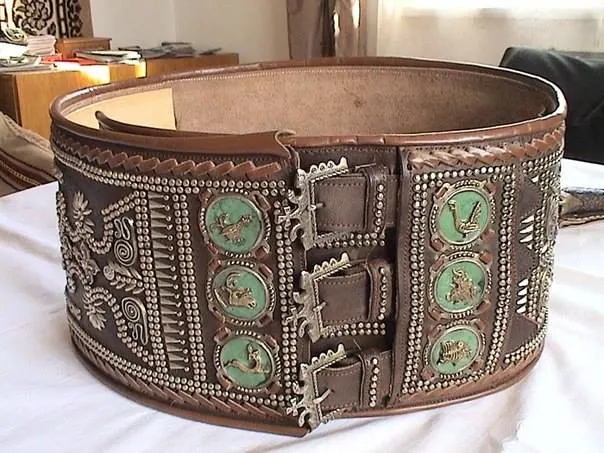
Ducats, for instance, were necklaces of real gold coins strung together, often interspersed with glass or coral beads. In Bukovyna, women wore a silver variant called salby, which eventually evolved from a strung coin necklace into coins sewn directly onto fabric — traditionally a first-birthday gift from a godfather, and a style shared with several other Slavic and Turkic peoples in the region. The zgarda, meanwhile, is a distinctly Hutsul amulet-necklace: a set of cast crosses in brass or copper strung on a strap, first gifted to a girl at six years old and added to year after year until the crosses built up into overlapping rows. Despite the Christian cross shape, the custom itself is considerably older than the symbolism suggests. The heaviest zgardy, built around a large crucifix, were called “hazdivski” — reserved for wealthy, respected men, from “gazda,” the word for the man of a household.
Simpler still was the patsyorka, a single-strand necklace originally made from cheap translucent glass before Venetian beads became the fashionable upgrade — one of a whole family of western Ukrainian beaded jewelry alongside gerdan and sylyanka. Kryzy were wide, round beaded collars worked in geometric or floral patterns, covering the neck, chest and shoulders in a way a simple necklace never could, while sylyanka (also called pletinka) referred to multicolored beaded strips whose protective strength was, by tradition, tied to the specific pattern worked into them. Taken together, these pieces map out something a single necklace style never could: how much a small strand of coins, glass or beads was made to carry across a life.