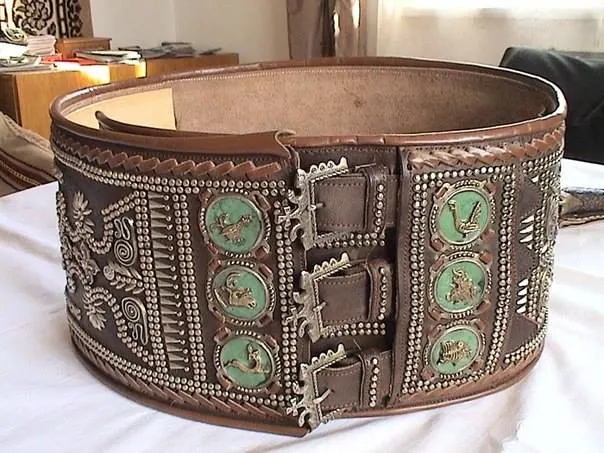
The cheres is a wide leather belt, cut from a single piece of smooth cowhide and worn by Hutsul men over the shirt and trousers — and it did a lot more work than a modern belt ever does. Ranging from 20 to 45 cm wide and fastened with anywhere from one to six buckles, the biggest cheres needed small underarm cutouts just so the wearer could move his arms. Because a fully loaded belt could get genuinely heavy, brass chains slung over the shoulders were often used to help carry the weight.
Its size made it useful in exactly the way you’d expect: pockets sewn along the top stored bullets and coins, while rings and hooks carried a tobacco pouch, a small folding knife, or the topirets — the same ceremonial axe-and-walking-stick shepherds and dancers alike are known for. Beyond the practical side, a cheres protected the torso in a fight and braced the core during the genuinely hard physical labor of shepherding or log-rafting down mountain rivers. It was also, unmistakably, a status symbol — Hutsul tradition held that a young man only truly became a man once his father gifted him his own cheres.
The belt carried real superstition too. Shepherds believed running a flock across a cheres laid on the ground in spring would protect the animals from predators and help them breed successfully, and in some villages children were buried wearing a red belt, believed to guard against evil spirits and clear the way for rebirth — a belief that, strikingly, turns up almost identically in traditions half a world away in India.