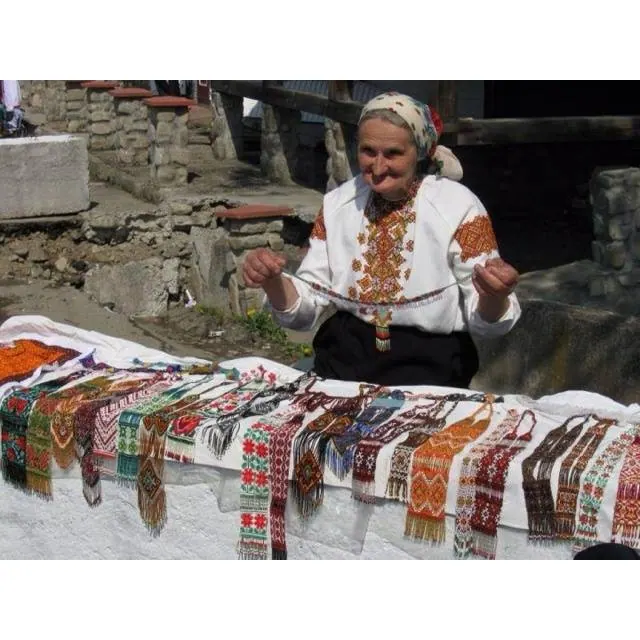
A gerdan is a narrow strip of colored beads, strung on thread or fishing line into a geometric or floral pattern and worn looped around the neck — or, in some regions, sewn onto a hat instead. Depending on where you are, the same basic idea goes by different names too: sylianka, pletenka, drabynka. It’s a craft mostly associated with western Ukraine — Halychyna, Bukovyna and Transcarpathia — and largely unknown in the east, with one widely held theory tracing its arrival in Galicia back to Hungary.
Beadwork itself is far older than any single Ukrainian region, though — glass beads trace back to ancient Egypt, travelled to Europe through Byzantium, and picked up serious momentum once Venice became known as the glassmaking capital of the world. Beads reached Ukraine early too: archaeological finds from 8th–12th century graves point to a real glassmaking tradition already established in Kyivan Rus’. By the 19th century, beaded gerdans were a fixture of folk dress across western Ukraine, prized enough that a well-made one could be worth more than a family’s entire household.
The patterns weren’t arbitrary, either. Horizontal lines stood for land, wavy lines for water, a cross for fire, and a rhomb, circle or square for the sun — a whole visual vocabulary built from geometry. Hutsul beadwork in particular leaned into bright, saturated color, echoing the forests, meadows and mountain streams around it. Beaded accessories were also treated as amulets, believed to absorb something of the mood and intentions of whoever made them — which is part of why gerdan-making was never meant to be done in a bad mood, and why a gerdan was traditionally never passed on as a gift to someone else.