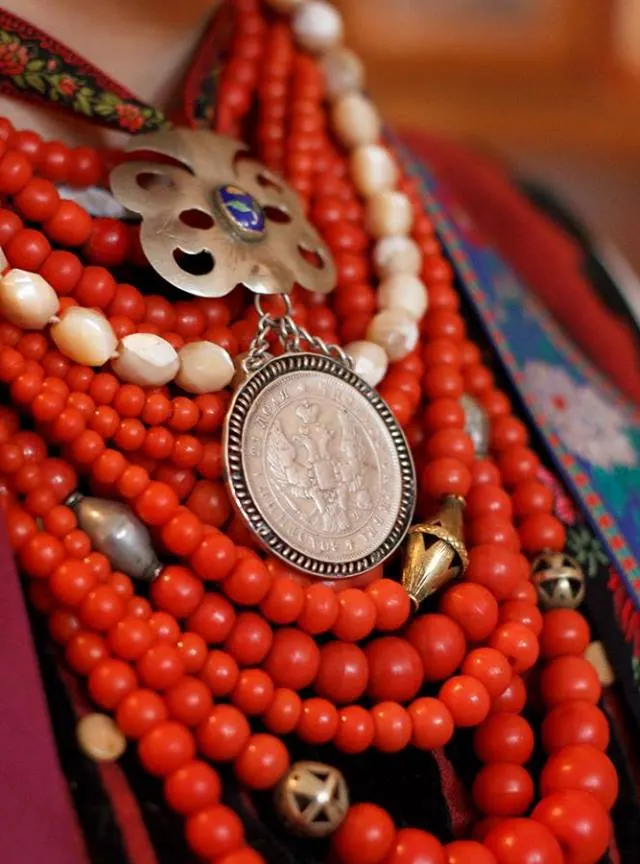
A dukach is a medal-shaped pendant worn on a ribbon around the neck, traditionally marking a girl’s passage from childhood into adulthood — and its name is a direct borrowing from “ducat,” the Western European gold coin that first reached Ukraine through Venice in the 13th century. By the 19th and 20th centuries, dukaches ranged wildly in value, from finely worked jewelry to plain stamped-metal plaques, but even the simplest ones mattered: they were worn on both festive and ordinary days, passed from mother to daughter, and when a family had to buy or commission one from a craftsman instead, it could cost more than everything else the household owned.
The classic form paired a medal with a bow-shaped brooch — a ribbon tied into four loops with a small crown nestled between the top two — sometimes finished with a piece of faceted glass, a style most associated with Left-Bank Ukraine. Genuine 17th- and 18th-century European and Russian medals were sometimes repurposed as the pendant itself, though most were purpose-made by goldsmiths using a stamping technique, often paired with matching earrings and rings. The plainest versions were just dark copper or light brass, standing in for gold.
One particular style, the ‘koronatka’ or “crown dukach,” traces back to the Catholic Church’s practice of ceremonially crowning icons, starting with the first such coronation in 1717 — special medals were struck in Rome for the occasion, usually depicting the Virgin Mary or the Heart of Jesus, and this style became especially associated with the Poltava region. Later dukaches often carried portraits of empresses instead, Catherine the Great above all, copied and re-copied so many times over the generations that her likeness gradually blurred into something else entirely — a whole visual era compressed into one well-worn coin.